 Add to Chrome
 Add to Firefox
 Add to Edge
Understanding LLM Behavior in Multi-Target Cross-Lingual Summarization
May 31, 2026
Multi-target cross-lingual text summarization (MTXLS), which summarizes a source document into multiple target languages, is increasingly important as users consume content in diverse languages, but remains underexplored. To address this gap, we introduce multi-target cross-lingual element-aware (MEA), a new MTXLS benchmark covering 24 target languages. We benchmark end-to-end and pipeline approaches across various LLMs and show that MTXLS performance still substantially lags behind English monolingual summarization. To better understand MTXLS in LLMs, we propose a layer-wise analysis framework for investigating how LLMs internally perform MTXLS. Our analyses suggest that translation and summarization behaviors emerge jointly within later layers rather than as distinctly decomposed stages. Most task-relevant processing occurs within these layers, and errors also tend to arise at similar depths. Motivated by these findings, we introduce an inference-time activation steering method that leverages hidden representations from English summarization to guide MTXLS generation. Experiments show that our method consistently improves MTXLS quality across target languages.

ChunkFT: Byte-Streamed Optimization for Memory-Efficient Full Fine-Tuning
May 20, 2026This work presents \textsc{ChunkFT}, a memory-efficient fine-tuning framework that reformulates full-parameter fine-tuning around a dynamically activated working set. \textsc{ChunkFT} enables gradient computation for arbitrary sub-tensors without modifying the network architecture, providing an algorithmic foundation for optimizing arbitrary sub-networks while avoiding standard dense gradient computation. We provide a theoretical convergence analysis of \textsc{ChunkFT} in the deterministic setting. Empirically, we apply \textsc{ChunkFT} to fine-tune Llama 3-8B and Llama 3-70B using a single RTX 4090-24GB GPU and 2$\times$ H800-80GB GPUs, respectively. Full-parameter fine-tuning of a 7B model with a 1K input length requires only 13.72GB of GPU memory. The results demonstrate the effectiveness of \textsc{ChunkFT} in memory usage, running time, and optimization quality. Moreover, downstream evaluations on language understanding, mathematical reasoning, and MT-Bench show that \textsc{ChunkFT} consistently outperforms existing memory-efficient baselines. Notably, \textsc{ChunkFT} achieves performance comparable to, and in some cases exceeding, full-parameter fine-tuning. Our repository is on https://github.com/misonsky/chunk.
DiM\textsuperscript{3}: Bridging Multilingual and Multimodal Models via Direction- and Magnitude-Aware Merging
May 13, 2026Towards more general and human-like intelligence, large language models should seamlessly integrate both multilingual and multimodal capabilities; however, extending an existing multimodal model to many languages typically requires expensive multilingual multimodal data construction and repeated end-to-end retraining. We study a training-free alternative: injecting multilingual capability into an existing multimodal model by composing residual updates in the shared language model backbone. The key challenge is that multilingual and multimodal updates are heterogeneous, reflecting different functional roles in the shared model. To address this, we propose Direction- and Magnitude-aware Multilingual Multimodal merging (DiM3), which selectively composes the two updates at each parameter dimension while preserving the original vision encoder and multimodal projector. Experiments on multilingual benchmarks in both text-only and vision-language settings, covering 57 languages across LLaVA- and Qwen-based backbones, show that DiM3 consistently outperforms existing merging baselines, substantially improves multilingual performance over the original multimodal model, and remains competitive with dedicated multilingual multimodal fine-tuning while largely retaining general multimodal ability. We further show that DiM3 can be directly applied to already trained multilingual multimodal models and still yield additional gains. Further interpretability analysis shows that DiM3 primarily reshapes intermediate-layer semantic representations, strengthening cross-lingual alignment under both text-only and multimodal inputs while preserving higher-layer task-sensitive structure. Our repository is on https://github.com/wzj1718/DiM3.
Sky-Ear: An Unmanned Aerial Vehicle-Enabled Victim Sound Detection and Localization System
Apr 14, 2026Unmanned Aerial Vehicles (UAVs) are increasingly deployed in search-and-rescue (SAR) missions, yet continuous and reliable victim detection and localization remain challenging due to on-board hardware constraints. This paper designs an UAV-Enabled Victim Sound Detection and Localization System (called ``Sky-Ear'' for brevity) to achieve energy-efficient acoustic sensing and sound detection for SAR. Based on a circular-shaped microphone array, two-stage (Sentinel and Responder) audio processing is developed for energy-consuming and highly reliable sound detection. A Masking autoencoder (MAE)-based sound detection method is designed in the Sentinel stage to analyze frequency-time acoustic features. For improved precision, a continuous localization method is designed by optimizing detected directions from multiple observations. Extensive simulation experiments are conducted to validate the system's performance in terms of victim detection accuracy and localization error.
The Anatomy of an Edit: Mechanism-Guided Activation Steering for Knowledge Editing
Mar 21, 2026Large language models (LLMs) are increasingly used as knowledge bases, but keeping them up to date requires targeted knowledge editing (KE). However, it remains unclear how edits are implemented inside the model once applied. In this work, we take a mechanistic view of KE using neuron-level knowledge attribution (NLKA). Unlike prior work that focuses on pre-edit causal tracing and localization, we use post-edit attribution -- contrasting successful and failed edits -- to isolate the computations that shift when an edit succeeds. Across representative KE methods, we find a consistent pattern: mid-to-late attention predominantly promotes the new target, while attention and FFN modules cooperate to suppress the original fact. Motivated by these findings, we propose MEGA, a MEchanism-Guided Activation steering method that performs attention-residual interventions in attribution-aligned regions without modifying model weights. On CounterFact and Popular, MEGA achieves strong editing performance across KE metrics on GPT2-XL and LLaMA2-7B. Overall, our results elevate post-edit attribution from analysis to engineering signal: by pinpointing where and how edits take hold, it powers MEGA to deliver reliable, architecture-agnostic knowledge edits.
Fair Benchmarking of Emerging One-Step Generative Models Against Multistep Diffusion and Flow Models
Mar 15, 2026State-of-the-art text-to-image models produce high-quality images, but inference remains expensive as generation requires several sequential ODE or denoising steps. Native one-step models aim to reduce this cost by mapping noise to an image in a single step, yet fair comparisons to multi-step systems are difficult because studies use mismatched sampling steps and different classifier-free guidance (CFG) settings, where CFG can shift FID, Inception Score, and CLIP-based alignment in opposing directions. It is also unclear how well one-step models scale to multi-step inference, and there is limited standardized out-of-distribution evaluation for label-ID-conditioned generators beyond ImageNet. To address this, We benchmark eight models spanning one-step flows (MeanFlow, Improved MeanFlow, SoFlow), multi-step baselines (RAE, Scale-RAE), and established systems (SiT, Stable Diffusion 3.5, FLUX.1) under a controlled class-conditional protocol on ImageNet validation, ImageNetV2, and reLAIONet, our new proofread out-of-distribution dataset aligned to ImageNet label IDs. Using FID, Inception Score, CLIP Score, and Pick Score, we show that FID-focused model development and CFG selection can be misleading in few-step regimes, where guidance changes can improve FID while degrading text-image alignment and human preference signals and worsening perceived quality. We further show that leading one-step models benefit from step scaling and become substantially more competitive under multi-step inference, although they still exhibit characteristic local distortions. To capture these tradeoffs, we introduce MinMax Harmonic Mean (MMHM), a composite proxy over all four metrics that stabilizes hyperparameter selection across guidance and step sweeps.
Locate, Steer, and Improve: A Practical Survey of Actionable Mechanistic Interpretability in Large Language Models
Jan 20, 2026Mechanistic Interpretability (MI) has emerged as a vital approach to demystify the opaque decision-making of Large Language Models (LLMs). However, existing reviews primarily treat MI as an observational science, summarizing analytical insights while lacking a systematic framework for actionable intervention. To bridge this gap, we present a practical survey structured around the pipeline: "Locate, Steer, and Improve." We formally categorize Localizing (diagnosis) and Steering (intervention) methods based on specific Interpretable Objects to establish a rigorous intervention protocol. Furthermore, we demonstrate how this framework enables tangible improvements in Alignment, Capability, and Efficiency, effectively operationalizing MI as an actionable methodology for model optimization. The curated paper list of this work is available at https://github.com/rattlesnakey/Awesome-Actionable-MI-Survey.
SAD: A Large-Scale Strategic Argumentative Dialogue Dataset
Jan 12, 2026Argumentation generation has attracted substantial research interest due to its central role in human reasoning and decision-making. However, most existing argumentative corpora focus on non-interactive, single-turn settings, either generating arguments from a given topic or refuting an existing argument. In practice, however, argumentation is often realized as multi-turn dialogue, where speakers defend their stances and employ diverse argumentative strategies to strengthen persuasiveness. To support deeper modeling of argumentation dialogue, we present the first large-scale \textbf{S}trategic \textbf{A}rgumentative \textbf{D}ialogue dataset, SAD, consisting of 392,822 examples. Grounded in argumentation theories, we annotate each utterance with five strategy types, allowing multiple strategies per utterance. Unlike prior datasets, SAD requires models to generate contextually appropriate arguments conditioned on the dialogue history, a specified stance on the topic, and targeted argumentation strategies. We further benchmark a range of pretrained generative models on SAD and present in-depth analysis of strategy usage patterns in argumentation.
PlaM: Training-Free Plateau-Guided Model Merging for Better Visual Grounding in MLLMs
Jan 12, 2026Multimodal Large Language Models (MLLMs) rely on strong linguistic reasoning inherited from their base language models. However, multimodal instruction fine-tuning paradoxically degrades this text's reasoning capability, undermining multimodal performance. To address this issue, we propose a training-free framework to mitigate this degradation. Through layer-wise vision token masking, we reveal a common three-stage pattern in multimodal large language models: early-modal separation, mid-modal alignment, and late-modal degradation. By analyzing the behavior of MLLMs at different stages, we propose a plateau-guided model merging method that selectively injects base language model parameters into MLLMs. Experimental results based on five MLLMs on nine benchmarks demonstrate the effectiveness of our method. Attention-based analysis further reveals that merging shifts attention from diffuse, scattered patterns to focused localization on task-relevant visual regions. Our repository is on https://github.com/wzj1718/PlaM.
HyperVL: An Efficient and Dynamic Multimodal Large Language Model for Edge Devices
Dec 16, 2025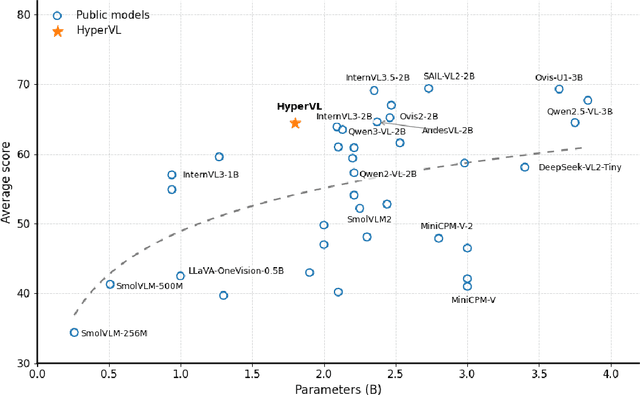

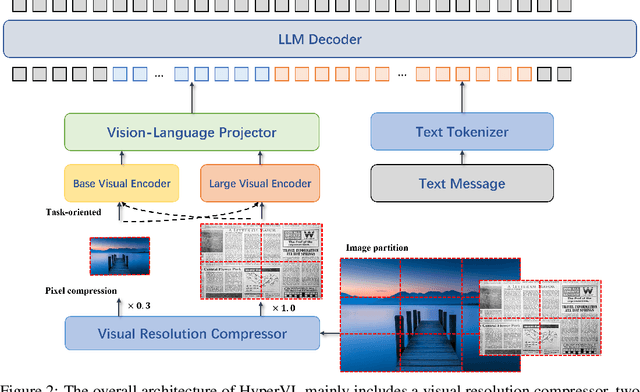
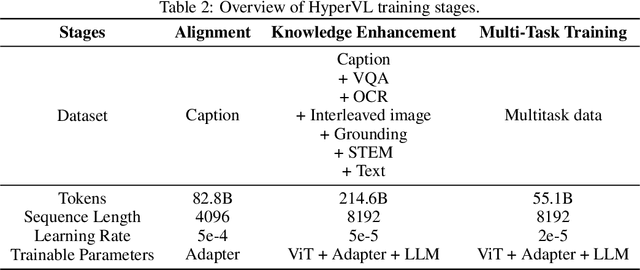
Current multimodal large lanauge models possess strong perceptual and reasoning capabilities, however high computational and memory requirements make them difficult to deploy directly on on-device environments. While small-parameter models are progressively endowed with strong general capabilities, standard Vision Transformer (ViT) encoders remain a critical bottleneck, suffering from excessive latency and memory consumption when processing high-resolution inputs.To address these challenges, we introduce HyperVL, an efficient multimodal large language model tailored for on-device inference. HyperVL adopts an image-tiling strategy to cap peak memory usage and incorporates two novel techniques: (1) a Visual Resolution Compressor (VRC) that adaptively predicts optimal encoding resolutions to eliminate redundant computation, and (2) Dual Consistency Learning (DCL), which aligns multi-scale ViT encoders within a unified framework, enabling dynamic switching between visual branches under a shared LLM. Extensive experiments demonstrate that HyperVL achieves state-of-the-art performance among models of comparable size across multiple benchmarks. Furthermore, it significantly significantly reduces latency and power consumption on real mobile devices, demonstrating its practicality for on-device multimodal inference.